Leaf logo

Pride of New York


I Love New York

New York State Pure Maple Products
New York State Maple Producers Association, Inc.

April 8, 2008
Ag Literacy Day Lesson Plan, Exploring Maple Syrup, to supplement "Sugarbush Spring"

On April 8, volunteers throughout the state will read a book with an agricultural theme to second graders to promote the understanding and appreciation of agriculture and the food and fiber system.

The maple industry is getting a big boost with the selection of the book “Sugarbush Spring” by Marsha Wilson Chall as this year’s book for Ag Literacy Day for second-graders. This annual event to draw attention to the state’s farm industry is sponsored by New York Agriculture In The Classroom, with support from Cornell Cooperative Extension, Agway Foundation and, this year, the Maple Producers Association.

Download Lesson plan online


2007 New York State Maple Queen and Princess Crowned

The Maple Queen and Princess pageants were held May 19 at the American Maple Museum in Croghan, where the event has been held continuously since 1980.

Ariel Zaleski (left) of Edmeston, NY, representing Ostego County, was selected the New York State Maple Princess from a group of six finalists. The 14 year old contestant is the daughter of Robert and Karen Zaleski, she comes from a long line of maple producers including her grand parents Ben and Judy Benjamin of Edmeston. The new New York Maple Queen is Lacey Pitman of Marathon, NY in Chenango County. Queen Lacey, selected from a group of five finalists, is the daughter of John and Denise Pitman. She is a fourth generation sugarmaker. (Larry Myott photo)

The New York Maple royalty participate in public events throughout the state, including parades, the State Fair, local fairs, the New York Maple Tour and more.  A pageant is planned in Jan. 2008 in Verona, NY, for girls who do not have a local county pageant to compete in where they live. Registration materials >>>


New York maple syrup 2007 production down 11 percent
Syrup production is estimated at 224,000 gallons, down from the 253,000 gallons produced in 2006 according to Stephen Ropel, Director of USDA’s National Agricultural Statistics Service, New York Field Office. Only two states, Vermont and Maine, produced more syrup. The number of taps, 1.47 million, decreased 4 percent from last year. Syrup produced per tap averaged 0.152 gallons, down from 0.165 gallons in 2006.

The final value of the 2006 crop was also announced by the Statistics Service. It was $8.02 million, 14 percent above 2005’s value of production. However, the overall price was $31.70/gallon, the same as the 2005 price. MORE >>>


From the Tree to Your Table

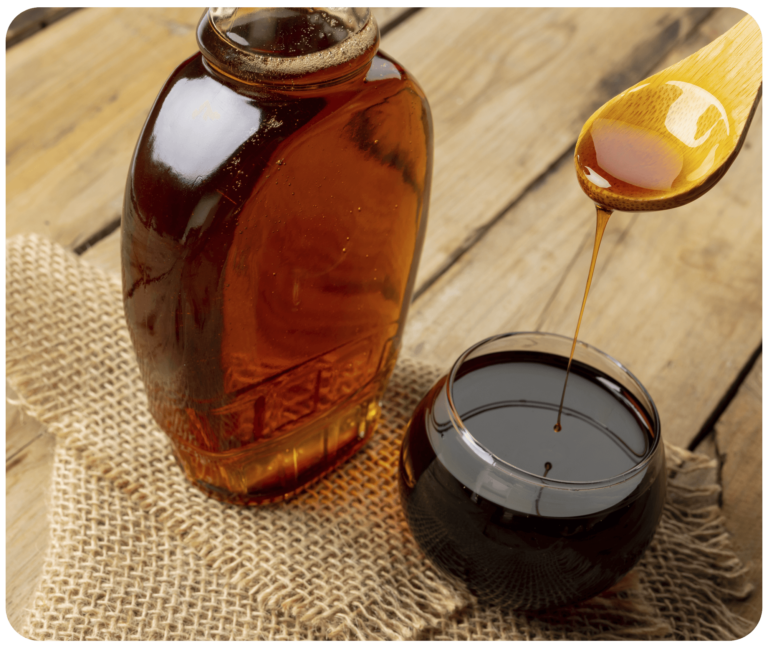
Maple syrup products displayAs winter grudgingly gives way to spring, New York State maple syrup producers begin the work of making maple syrup. The temperature climbs to the 40’s in the day and eases back below freezing at night. Warm days and cool nights cause the sap to run through the trees. This is known as the “sugaring off” season.

A sugar maple tree is usually 30 years old or more and at least ten inches in diameter before it is tapped. Depending on its size, a tree can have up to four taps, each of which yields an average of ten gallons of sap per season.

Tapping maple tree with battery operated drillA large number of New York’s maple producers have put away their metal spiles and buckets. They save time and collect more sap by connecting their maple trees, collectively known as a sugarbush, with a network of plastic tubing. The sap flows to collecting vats or, in some larger operations, is pumped directly to the sugar house. This is where the sap is transformed into syrup.

When the sap first arrives in the sugarhouse it is mostly water and bears little resemblance to the beautiful amber liquid we eventually use on our pancakes. The sap to syrup conversion happens when most of the water s boiled away. During “sugaring off” season, sap is evaporated continuously until the supply of sap is converted to pure maple syrup. It takes about 40 gallons of sap to make one gallon syrup.

This evaporation process, like the collection of sap from the trees, has been completely modernized. New York State maple producers use sophisticated equipment to control the evaporation process and make the most efficient use of the fuel used for this process.

Open Sugar Houses

Many sugar houses are open to the public during maple season and at other times of the year. Look for these signs like these along highways or on sugar houses. New York’s maple producers are very proud of what they do and are always willing to share their interest and knowledge.

Maple sign


Visit the American Maple Museum in Croghan, New York. Exhibits depict the history of maple syrup and sugar making techniques ranging from those used by the Native Americans to plastic tubing and stainless steel evaporators in use today. Audio tapes explain many of the exhibits. The Museum was founded in 1977 to preserve the history and evolution of the North American maple syrup industry. Admission charged. Call ahead for Museum hours (315) 346-1107. More >>>

American Maple Museum in Croghan, NY


to top of page

©2005, 2006, 2007, 2008 New York State Maple Producers Association
web design by Ghostwriters Communications, Inc.

Last updated April 8, 2008